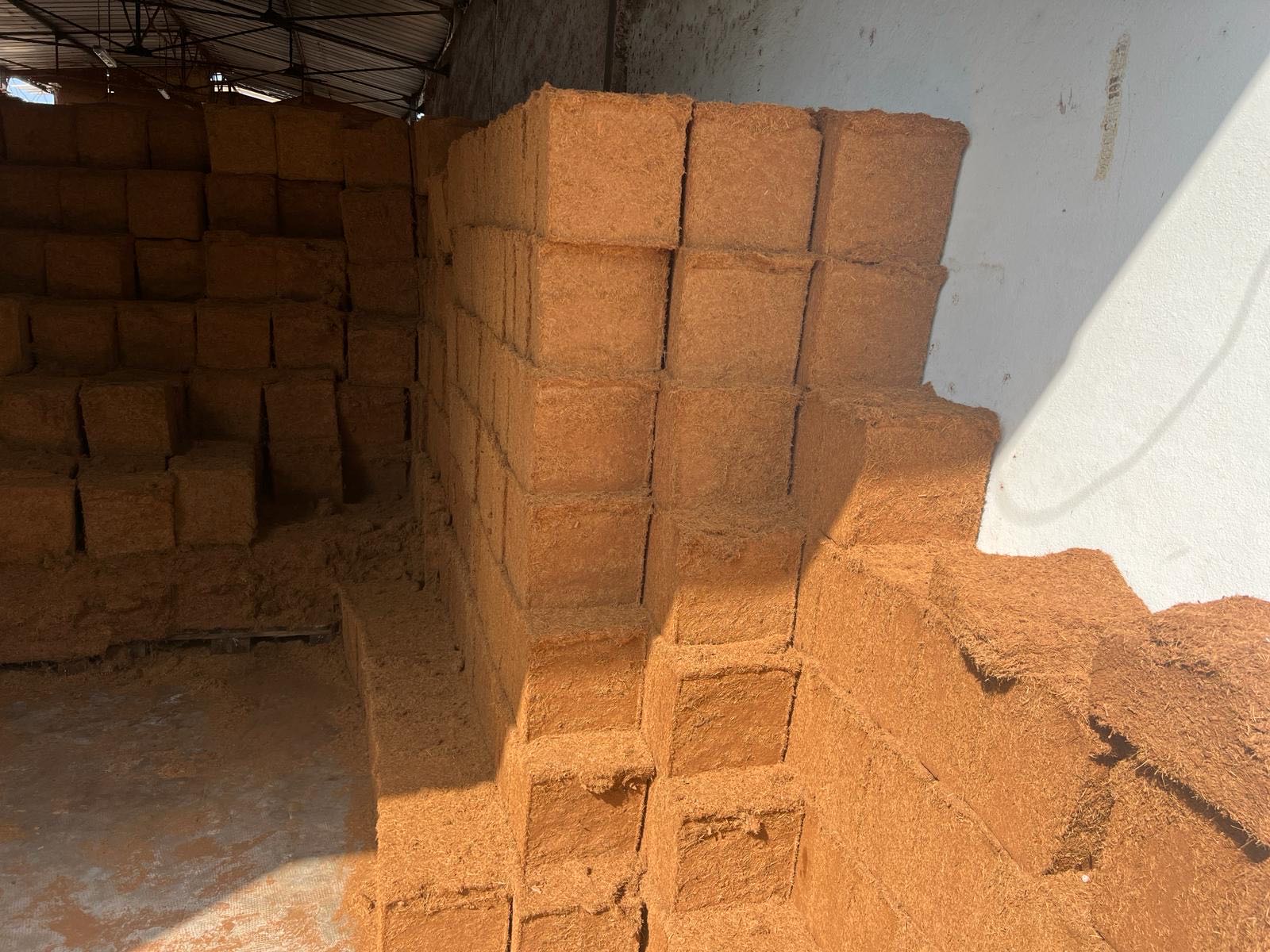
The Benefits of Coco Peat for Soil Health and Crop Production
In the search for effective substrates and soil amendments for African agriculture, coco peat — also known as coco fiber, coir dust, or coco coir — is increasingly emerging as a solution of choice. Derived from a resource abundant across the continent, it offers remarkable properties for greenhouse cultivation, nursery production, and open-field soil improvement.
Here’s everything you need to know about this exceptional agricultural material and how it can transform your farming practices.
What is Coco Peat?
Coco peat is obtained from the fibrous husk (mesocarp) of coconuts. After the long fibers used in the textile and rope industries are extracted, what remains is a fine powder and short fibers: this is coco peat. This byproduct, long considered waste from the coconut industry, is now recognized as one of the best growing media and soil amendments available.
Its composition gives it exceptional physical and chemical properties for plant growth:
- High water retention — coco peat can absorb 8 to 10 times its own weight in water, then release it gradually to the roots
- Excellent aeration — despite this retention capacity, its porous structure maintains air pockets in the substrate, preventing root suffocation
- Naturally balanced pH — between 5.5 and 6.8, suitable for the vast majority of crops without prior correction
- Pathogen-free — the processing removes germs and parasites naturally present in the original plant material
Benefits for African Agriculture
Optimized Water Management
In semi-arid zones or during dry seasons, controlling water use is decisive for successful crops. Coco peat mixed into soil or used as a growing substrate acts as a buffer reservoir: it absorbs excess irrigation or rain water and releases it gradually as the soil starts to dry.
In practice, this translates into:
- A 30 to 50% reduction in irrigation frequency, depending on crop and base soil
- Prevention of waterlogging even during heavy rain, thanks to the substrate’s good internal drainage
- Stable moisture levels around the roots, avoiding the stress-and-excess cycles that weaken plants
Enhanced Root Development
The light, aerated structure of coco peat creates an ideal environment for root colonization. Roots develop freely in all directions, without obstruction or compaction. This vigorous root development directly translates into better nutrient and water uptake, and stronger, more productive plants.
In addition, the absence of pathogens and coco peat’s naturally mild inhibitory effect on certain soil fungi (such as Pythium and Fusarium) reduce damping-off and root rot — two leading causes of loss in nurseries and protected cultivation.
Improved Structure of Heavy Soils
Compact clay soils — common across many West African farming regions — cause serious problems: excessive runoff, surface compaction, and waterlogging during the rainy season. Incorporating coco peat significantly improves the porosity and structure of these soils, making them more permeable, easier to work, and more hospitable to microbial life.
For sandy soils, on the other hand, coco peat acts like a sponge that holds onto water and nutrients that would otherwise quickly leach away.
Soilless Growing Substrate
In soilless greenhouse cultivation — particularly for tomatoes, peppers, cucumbers, and other cucurbits — coco peat has become the global substrate of reference, steadily replacing rockwool because of its natural origin and biodegradability.
Supplied as growing bags or rehydratable blocks, it provides an ideal medium for hydroponic or semi-hydroponic systems. With rigorous nutrition and irrigation management, yields of 15 to 20 kg per square meter per season are achievable for cherry tomatoes, for example.
Sustainability and Recyclability
Coco peat is a renewable resource made from an agricultural byproduct. Its production has a far lower carbon footprint than peat extracted from natural peat bogs. After several growing cycles, the spent substrate can be worked back into the soil as an organic amendment, closing a virtuous loop of reuse.
Practical Applications
Coco peat can be used in several ways depending on your goals:
In nurseries: mixed with soil and compost in a 1:1:1 ratio, it makes an outstanding seed-starting and transplanting substrate — light, well-drained, weed-free, and favorable to young plant rooting.
In greenhouse cultivation: as soilless growing slabs for hydroponic or fertigated crops, lasting 2 to 3 seasons depending on management.
As a soil amendment: incorporated at 10 to 20% of volume into the top 20 cm of soil, it durably improves the physical properties of heavy or very sandy soils.
As mulch: applied on the surface around plants, it reduces evaporation, limits weed growth, and keeps the soil cool.
How to Choose Quality Coco Peat
Not all coco peat products are equal. Here’s what to check before buying:
- Salt content: good coco peat should have an electrical conductivity (EC) below 0.5 mS/cm. Salt levels that are too high can burn young plant roots.
- pH: check that it falls between 5.5 and 6.8.
- Particle size: a mix of fine and medium fibers gives the best balance between water retention and aeration.
- Certifications: favor suppliers who certify their product free of pesticide residues and pathogens.
Coco peat is one of those agricultural inputs that, once adopted, permanently changes the way you grow. Its versatility, effectiveness, and environmental qualities make it a valuable ally for any African farmer looking to improve yields and soil health.
Arbre Bio Africa distributes professional-grade coco peat and growing substrates, selected and tested to meet the most demanding standards. It pairs especially well with precision irrigation and greenhouse cultivation, where controlled water delivery lets the substrate’s retention properties do their best work. Our team can advise you on quantities, blends, and application methods suited to your situation. Contact us to learn more about our products and pricing.